
Guaranteeing the integrity of all individuals present in a public facility, without exception and ambiguity, represents today a major issue for schools, medical-social facilities, hospitals, territorial communities and any site hosting public or employees.
Towards a universal alert system in public facilities
Due to the multiplication of the risks of fires, intrusions, assaults, technical accidents, natural disasters or health events, the capacity to inform quickly, clearly and efficiently all the occupants of a public building has become a fundamental pillar of collective security.
Regulatory measures such as Safety plans or the Martyn’s Law precisely outline actions to take in an emergency situation. They define roles, procedures, information channels and ways of communication to activate depending on the nature of the danger. Their objective is clear: avoid panic, coordinate actions and protect individuals.
However, despite their strategic importance, an essential issue often remains under-estimated: how to make sure that information is actually perceived and understood by all, included by deaf or hearing-impaired individuals? This issue is not a marginal case. It is at the heart of the concept of equality to the risk, accessibility and responsibility of public facility supervisors.
At a time where public buildings invest massively for securing their premises, the inclusive dimension of alert systems should become a fully-fledged pillar of prevention. A universal alert is not only a powerful or quick alert: it is an alert which leaves no one with no information, which adapts to the sensory capacities of each individual and enables instant understanding of the situation.

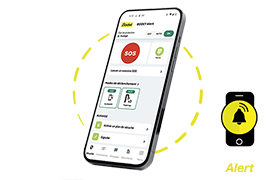
Stellen Sie sicher, dass Ihre Einrichtung den schulischen Notfall- und Krisenplan erfüllt
Setzen Sie auf eine zertifizierte Alarmlösung, die die sofortige Sicherheit aller Personen in Ihrer Einrichtung gewährleistet.
A signal that should be heard...and seen
In most facilities, alert systems are still based on sound broadcasting. Sirens, fire alarms, voice messages, specific bells or announcements via speakers are the most common means of communication. For a large part of the population, such systems are efficient and allow for quick responsiveness.
However, this approach quickly shows its limits, when confronted to the diversity of hearing profiles present in public facilities. According to the British Academy of Audiology, at least 4.4 million people with hearing loss are of working age.. And 2 million people in the UK are hearing aid users. These figures take a specific dimension in some establishments: inclusive schools, special schools, supported employment workplaces, nursing homes, foster homes, hospitals or medical-social facilities, where the proportion of individuals concerned is often more important than in the general population.
For such an audience, using exclusively sound broadcasting for triggering alarms does not guarantee any reliable perception of danger, or an appropriate response. A deaf individual cannot hear the siren, ignores completely that an alert is being triggered and pursues its activity without being aware of the risk. A hearing-impaired individual can hear a muffled noise, without understanding its meaning or seriousness. In both cases, the safety chain is weakened.
However, in an emergency situation, every second counts. In the event of fire, malicious intrusion or an event requiring immediate lockdown, the fastness of the alert signal detection has a direct impact on the safety of all individuals. Not perceiving the alarm means remaining isolated, moving in a dangerous zone or delaying collective evacuation.
As a result, safety can no longer lie on what is heard. It should also be seen, understood and integrated instantly, whatever the sensory means available.
Hearing impairment and emergency situations: a specific vulnerability
Hearing impairment is not limited to the complete absence of hearing. It includes a wide range of situations: mild, moderate or severe hearing loss, total deafness, partial hearing aid, auditory fatigue or temporary trouble. This diversity makes alert management even more complex.
Some hearing-impaired individuals perceive sounds, but in a muffled or distorted manner. Others hear the alarm without being able to distinguish its nature or understand voice announcements. In a noisy environment such as a sports hall, a workshop, a canteen or a school playground, even a powerful alarm can become inaudible or incomprehensible.
Besides, stress related to an emergency situation strengthens difficulties of comprehension. A voice announcement that is too fast, too technical or broadcast in poor acoustic conditions can confuse part of the audience, including hearing individuals. For deaf or hearing-impaired people, this represents a complete barrier.
Adapting safety plans then implies to anticipate such situations, simplify messages and favour supports that are immediately readable and identifiable.
From regulatory obligations to inclusive commitment
From the Equality Act of 2010 (in England, Wales, Scotland), accessibility of public facilities is no longer limited to installing access ramps or lifts. It also concerns information, communication and security systems. Alert systems are fully part of this scope.
Adopting a safety plan suitable for deaf or hearing-impaired individuals does not only come under a voluntary approach or a “bonus” in terms of comfort. It is a regulatory, ethical and organisational issue, directly related to the responsibility of the facility.
Facilities hosting vulnerable individuals are particularly affected. In special schools, supported employment workplaces, nursing homes, or adult daycare centres, accessibility of safety instructions has a direct impact on user protection. However, facilities considered as being “ordinary” are not to be undone: a school, a sports hall, a town hall or a cultural centre hosts necessarily individuals with different hearing capabilities, whether users, visitors or staff.
The adaptation of safety plans then implies to rethink the way that emergency information is broadcast, tested and understood. Is it perceived by all? Is it immediately identifiable as an alert? Is it consistent with the instructions displayed and drills carried out? An accessible alert is an alert which reduces areas of uncertainty and strengthens the collective capacity to act in a coordinated way.
Limits of traditional alert systems
Traditional alarm systems have been designed at a time when the issue of sensory accessibility was not widely considered in safety discussions. They are based on a simple principle: a single audible signal, broadcast across all the premises, and supposed to trigger immediate response.
Nowadays, this model shows its limits. In fact, a deaf or hearing-impaired individual does not perceive the siren, voice announcements, or tone variations supposed to indicate the nature of the danger. In a classroom, a workshop, an office or an healthcare room, said individual can pursue its activities without even knowing that a protocol has been activated.
This lack of information does not only endanger the person concerned. It also makes action of supervising teams more complex, since they must intervene individually, sometimes urgently, to warn or help uninformed persons. This slows down the evacuation process, increases stress and weakens the global efficiency of the safety plan.
At the scale of an establishment, such malfunctions can have important consequences: disorganisation, delays, incomprehensions, even unintentional endangerment. As a result, diversifying alert channels becomes an essential lever for securing the whole chain.
Towards multi-sensory and synchronised alert systems
Due to the evolution of regulatory and societal requirements, facilities use more and more multi-sensory alert systems. The objective is clear: combining several types of signals to reach all occupants, whatever their hearing capabilities.
Such systems combineaudible signals for hearing persons, powerful and visible luminous signals, text messages displayed on screens or LED displays, and sometimes vibratory or touch-screen signals in some specific contexts.
In this case, the visual alarm plays a key role. A clearly identifiable luminous flash, associated with an explicit text message, enables deaf or hearing-impaired individuals to immediately be aware of the situation and react accordingly: evacuating, confining, or waiting for instructions.
Synchronisation is another key element. By using centralised systems, information is broadcast simultaneously in all areas of the facility. This simultaneity strengthens consistency of actions, avoids delayed response and limits misinterpretations.
Actually adapting a safety plan
Integrating an accessible alert in safety plans is not limited to installing new equipment. It implies a global discussion on emergency scenarios, messages broadcast and team training.
Instructions should be simple, visual and without ambiguity. Text messages should be short, readable and immediately understood. Colour codes, pictograms and luminous signals should be consistent with the instructions displayed in the facility.
Safety drills are also a key lever. Testing visual alert systems during lockdown or fire drills enables to confirm their visibility, comprehension and actual effectiveness. This fosters the appropriation of tools by all occupants, including deaf or hearing-impaired individuals.
.
Harmonys Trio: the advantage of triple signalling
Between the systems designed for making the alert completely inclusive, Harmonys Trio plays a central role. This wall-mounted casingassociates three complementary broadcasting modes: a bell, a luminous flash and a voice message. All elements are triggered in a perfectly synchronised way.
Installed in classrooms, workshops, hallways or common areas, Harmonys Trio guarantees immediate perception of the alert, including for deaf or hearing-impaired individuals. The flash draws attention, the voice message warns hearing persons and the bell strengthens the visibility of the event.
Beyond emergency situations, Harmonys Trio can also be used for daily communication. This regular use reinforces familiarity with the system and enhances its efficiency in critical situations.
An inclusive alert, assurance of collective peace of mind
Implementing an accessible alert is not limited to carrying out a technical upgrade. It is a profoundly human approach, which aims at guaranteeing the right of each individual to be informed, protected and actor of its own safety. An inclusive alert enhances user trust, soothes teams, and enhances collective responsiveness.
By adapting safety plans, such facilities confirm their commitment to equality, accessibility and social responsibility. They transform regulatory constraint into a sustainable opportunity to enhance their organisation. By adapting safety plans for deaf or hearing-impaired individuals, facilities confirm their commitment to equality, accessibility and social responsibility. They transform regulatory constraint into a sustainable opportunity to enhance their organisation.
This vision is completely in line with the philosophy of Bodet Time, which designs broadcasting and synchronisation solutions at the service of safety, accessibility and ease of use. Using tools such as Harmonys Trio enables to deploy an alert which is actually universal, understood by all and suitable for contemporary issues in risk management.
